Choosing a commercial painting contractor sounds straightforward until you start getting quotes and realise the prices vary by 40%, the specifications are all different, and you have no reliable way to judge which company will actually deliver what they’re promising. Here’s what to look for.
Check Their Commercial Track Record — Not Just That They Paint
Commercial painting is a different discipline to domestic decorating. The preparation standards, paint specifications, access requirements, working-while-occupied logistics, and health and safety obligations are all significantly more demanding. A company that paints houses competently isn’t automatically capable of delivering a commercial contract to the required standard.
Look for a contractor with a demonstrable track record of commercial projects in your sector. If you’re a retailer, have they worked for retailers? If you’re a manufacturer, do they have experience of industrial environments? If you’re a pub company or hospitality operator, do they understand the constraints of working around licensing hours and trading customers?
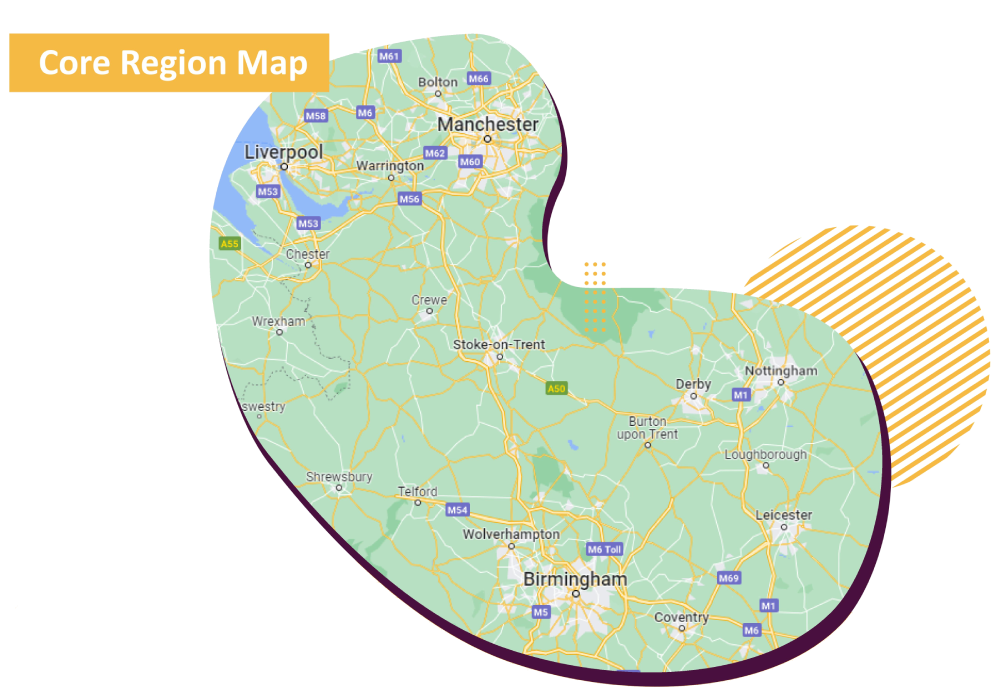
At Wallace Contracts, our commercial painting portfolio covers offices, retail, industrial, hospitality, care homes, schools and public buildings across Stoke-on-Trent, Manchester, Birmingham and the wider Midlands and North West.
Accreditations and Insurance
Any commercial painting contractor working on your premises needs adequate public liability insurance — check the level of cover and make sure it’s current. For larger or more complex contracts, clients increasingly ask for Constructionline or equivalent supply chain accreditation as a minimum standard.
Wallace Contracts are Constructionline Gold accredited, which means our health and safety, environmental management, financial standing and quality systems have been independently verified. We’re also Dulux Trade Contract Partners, which reflects our commitment to using properly specified, commercial-grade paint products rather than whatever’s cheapest at the point of purchase.
Understand What’s Actually in the Specification
Two painting quotes that look similar on price can represent dramatically different actual outcomes if the specifications differ. Key questions to ask:
How many coats? One mist coat and one finishing coat is not the same as full preparation, mist coat, two finishing coats. The difference is visible within months on a busy commercial building.
What’s the paint product and grade? Trade-grade commercial paints from manufacturers like Dulux are formulated for durability, coverage and scrub resistance in a way that consumer retail paints are not. If the specification doesn’t name the product, ask.
What preparation is included? Filling, sanding, priming and masking are time-consuming but make the difference between a finish that lasts and one that starts peeling within a year. A quote that’s significantly cheaper than others is often cheaper because the preparation has been cut.
Get a Proper Written Specification
A verbal agreement about “painting the office” is not a specification. Before you commission any commercial painting work, make sure you have a written document that describes the surfaces to be decorated, the preparation required, the paint products to be used, the number of coats, and any specific requirements around colour matching, protection of fittings, or working hours.
This protects you if the finished job doesn’t match your expectations, and it allows you to compare competing quotes on a genuinely like-for-like basis.
Consider Programme and Disruption
For commercial painting in occupied premises — which is most commercial painting — the programme matters as much as the price. A contractor who’s slightly more expensive but can complete the work out of hours, in phases around your operations, or to a tighter timeline may represent better value than a cheaper option that requires you to vacate the building for two weeks.
Ask specifically how the contractor plans to manage access, dust and fume protection, waste removal, and coordination with your occupants or customers. A contractor who’s done a lot of commercial work will have clear, practical answers. One who hasn’t may not.
References and Recent Work
Ask for references from recent commercial clients — ideally in your sector or with a similar project type. A contractor who’s genuinely proud of their work will have case studies and client contacts they’re happy to share. If they’re reluctant, that tells you something.
Our project case studies give a representative cross-section of our commercial painting and refurbishment work across Staffordshire and beyond. If you’d like to speak with a recent client about their experience of working with us, we’re happy to arrange that.
Getting a Quote
If you’re looking for a commercial painting contractor in Stoke-on-Trent, across Staffordshire, or anywhere across the Midlands and North West, we’d welcome the opportunity to discuss your project and provide a written quotation. Call us on 01782 717 507 or fill in our online enquiry form.
Dilapidations work on a car showroom brings its own challenges: large expanses of glazing, branded colour schemes tied to the manufacturer’s corporate identity, and a forecourt that can’t simply be closed while repairs happen. We recently completed dilapidations works at an Arnold Clark showroom in Rugeley, and it’s a good example of what this type of project actually involves.
Unlike a standard repaint, dilapidations work is measured against a schedule of condition set out in the lease — every wall, ceiling and fixture is assessed against what it should look like at handback, not just what needs a fresh coat of paint. If you haven’t come across the term before, we cover the basics in What Is a Schedule of Dilapidations and What Does It Mean for Your Business?
What made this project different
On a car showroom specifically, we had to work to the manufacturer’s exact colour and finish specification, protect display vehicles and glazing throughout, and keep the forecourt trading during the works. It’s a similar balancing act to the one we describe in The Benefits of Refurbishing Your Car Showroom, where presentation standards are just as important as the condition of the building itself.
Dilapidations and end-of-lease projects like this one are a core part of our work across Staffordshire and the wider Midlands — if you’re a landlord, tenant or letting agent facing a dilapidations schedule, get in touch for a survey and a straightforward breakdown of the works involved.
The phrase “commercial refurbishment” gets used to cover an enormous range of work — from a single room repaint through to a full strip-out and fit-out of an entire building. If you’re planning a refurbishment project and trying to understand what you’re actually commissioning, here’s a straightforward breakdown of what’s typically involved.
The Initial Survey and Scope
Any properly managed commercial refurbishment starts with a thorough site survey. This isn’t just a walkthrough to admire the problem — it’s the point at which a good contractor identifies everything that needs to happen in the right sequence, flags any issues that could affect programme or cost, and establishes what the end result actually needs to look like.
This stage matters more than most clients realise. A refurbishment that’s been properly surveyed and scoped is far more likely to be delivered on time and on budget than one that’s priced off a brief phone call. At Wallace Contracts, we always carry out a full site visit before providing a written quotation — it protects both sides.
Strip-Out
Many commercial refurbishments begin with some level of strip-out: removing existing fixtures, partitions, flooring, ceilings or fittings before the new works can begin. The scope of strip-out varies enormously — it might be lifting a carpet tile and removing a couple of partition walls, or it might be gutting an entire floor back to the structural shell.
Strip-out generates waste, which needs to be managed and disposed of correctly. A responsible contractor will have waste carriers’ licences, provide waste transfer notes, and demonstrate that materials are being disposed of legally — this matters particularly for clients who have environmental reporting obligations.
Building Work and Structural Changes
Depending on the scope, a commercial refurbishment may involve structural changes — moving or creating doorways, installing new partitioning, building extensions, or making alterations that require building regulations approval. Where this is the case, the work needs to be designed, approved and sequenced correctly before decoration or finishing trades begin.
For clients in Stoke-on-Trent and across the Midlands, Wallace Contracts handles building works as part of our multi-trade commercial refurbishment service, coordinating structural and building elements alongside decoration and fit-out to keep the programme tight.
Mechanical and Electrical Works
Heating, ventilation, lighting, data cabling and power all typically need to be addressed as part of a significant commercial refurbishment — either because the existing systems are being reconfigured, or because the new layout requires new service runs. These trades need to be coordinated carefully with the building and decoration programme so that ceilings and walls aren’t finished before cabling has been chased in, or lighting positions haven’t been agreed.
Decoration and Finishing Trades
For most commercial refurbishments, painting and decorating is the trade that clients and their customers notice most — it’s the finish that everyone sees. Getting this right means proper surface preparation (filling, sanding, priming) before a brush goes near the wall, using the right paint specification for the environment, and applying it to a standard that actually looks good rather than just technically qualifying as “decorated”.
We’re a Dulux Trade Contract Partner, which means our clients benefit from access to Dulux’s commercial-grade paint specifications and colour consultancy alongside our own application expertise. See our commercial painting and decorating services.
Flooring
Flooring is often one of the last trades to complete but one of the first decisions to make — because the floor specification affects what happens before it (screeds, underfloor heating, moisture barriers) and what happens after it (skirting, thresholds, furniture positioning). Getting the specification right for the use — a warehouse needs something different to a restaurant, which needs something different to an office — matters as much as the finish quality.
Programme Management and Sequencing
The difference between a commercial refurbishment that runs smoothly and one that overruns and causes disruption is usually programme management. Every trade needs to be on site at the right time, in the right sequence, with the right materials available. When that works, a refurbishment looks almost effortless from the client’s side. When it doesn’t, the delays compound and the cost consequences follow.
At Wallace Contracts, our project managers have delivered enough commercial refurbishments across Stoke-on-Trent, the Midlands and the North West to know where the pressure points are and how to manage them before they become problems.
Handover and Snagging
A proper handover means walking the finished project with the client, identifying and resolving any snagging items, providing relevant documentation (including any warranties, waste transfer notes and O&M information where applicable), and leaving the site clean and ready for occupation.
If you’re planning a commercial refurbishment in Stoke-on-Trent, Staffordshire, the Midlands or the North West, we’d welcome the opportunity to discuss your project. Call us on 01782 717 507 or fill in our online enquiry form.
Wallace Contracts Ltd has grown steadily from its roots in Stoke-on-Trent into a commercial contractor operating across a wide area of England and Wales. Over the course of more than 45 years, we have built relationships with clients in retail, hospitality, care, construction, education and property management — delivering projects from single-trade painting jobs to complex, multi-trade refurbishments worth hundreds of thousands of pounds.
As our client base has grown, so too has our geography. Today we regularly deliver projects across the Midlands, the North West, Wales and, for larger projects, anywhere in the UK. This post gives a clear picture of where we work, what we offer in each area and why businesses across the country choose Wallace Contracts to look after their properties.
Based in Stoke-on-Trent, Working Nationwide
Our headquarters is Unit 1 Sneyd Business Park in Stoke-on-Trent, Staffordshire — a central location that allows us to mobilise quickly to sites across a wide radius. Stoke-on-Trent sits at the heart of our operation and remains one of our most active areas, where we work for clients including JD Wetherspoon, Fuchs Lubricants, Hurstwood Holdings, Stoke-on-Trent City Council, Arnold Machin and many others.
For projects over approximately £10,000, we offer our full range of services anywhere in the UK. This nationwide capability has allowed us to support clients with large property portfolios — including national retailers, bookmakers, care providers and automotive groups — who need a consistent, reliable contractor they can trust across all their sites, not just those closest to our base.
The Midlands: Our Heartland
The Midlands is the area we know best. We work extensively across Staffordshire, the West Midlands, Shropshire, Worcestershire and the East Midlands, serving clients in Birmingham, Wolverhampton, Walsall, Telford, Shrewsbury, Nottingham, Leicester and Derbyshire.
In Birmingham, we have completed projects at the National Exhibition Centre for Magna Projects, office decoration packages for Oktra at Forrester’s head office and Ingenuity House, and retail refurbishments for Coral. In Walsall, we have delivered multiple refurbishment programmes for Ladbrokes and Coral, as well as care home works for Achieve Together and CareTech. In Wolverhampton, our work for Arnold Clark included converting existing rooms into classrooms within their car showroom.
Across Derbyshire, we have delivered an extensive multi-phase refurbishment programme for Eurocell at their Alfreton head office and Ilkeston recycling centre, covering toilet refurbishments, office upgrades, flooring installations and full internal decoration. In Nottingham, we have carried out refurbishment and maintenance works for Ladbrokes across multiple stores.
The North West: A Growing Area of Operation
The North West has become one of our most active regions, with a strong pipeline of work across Greater Manchester, Merseyside, Cheshire and Lancashire. We have delivered projects in Manchester, Liverpool, Stockport, Oldham, Wirral, Crewe and a number of smaller towns and cities across the region.
In Manchester, our portfolio includes decoration packages for Oktra at Sevendale House and multiple other office developments, internal decoration at Manchester University’s Williamson Building, refurbishments for CareTech and Hydes Brewery, and numerous projects for Rudy’s Pizza Napoletana, Jamieson Contracting and Coral. In Liverpool, we have completed multi-store refurbishment programmes for Ladbrokes, a comprehensive care home renovation for Mencap, internal decoration at Liverpool Lime Street Station for Jamieson Contracting, and floor and painting works for Arnold Clark.
In Stockport, our work includes the prestigious Stockport Exchange office development for Oktra and internal decoration for JD Wetherspoon at The Wilfred Wood. In Oldham, we have completed decoration works for JD Wetherspoon at both The Ash Tree and The Shay Wake. Across the Wirral and Birkenhead, we have delivered showroom refurbishments, fire door installations and specialist floor painting for Arnold Clark. In Crewe, our projects have included interior decoration at The Broughton restaurant for Parogon Group, office decoration for Assurant and retail refresh works for Frasers Group.
Wales: From North to South
Wallace Contracts is increasingly active across Wales, having delivered projects in North Wales, South Wales and Mid Wales. In Wrexham, we delivered a full decoration package for Wynne Construction at Wrexham University. In Llandudno, we have completed storefront repairs and redecoration for the British Heart Foundation and external decoration for Holland & Barrett. In Llanelli, we painted the café and swimming pool areas at Everlast Gyms. In Cardiff, we delivered internal decoration for Flannels.
We also delivered one of our most ambitious single projects in North Wales — a 13-week full conversion of a residential property into a fully operational care home, encompassing mechanical and electrical installations, fire safety systems, kitchen and bathroom fitting, external groundworks and full decoration throughout.
What We Offer: A Full Range of Commercial Property Services
Across all of these areas, we offer the same comprehensive range of services. Here is a summary of what Wallace Contracts can deliver for your property:
Commercial Painting & Decorating
Our core trade. We deliver internal and external decoration for commercial clients across all sectors, including retail, hospitality, care, office, industrial, education and healthcare. Our decorators are experienced in all finishes and surface types, from emulsion and satinwood through to specialist coatings, masonry paint and airless spray-painted suspended ceilings. We work at height using cherry pickers, mobile scaffold towers and fixed scaffolding, with all operatives holding relevant IPAF and PASMA qualifications.
Property Refurbishment
As an SSIP-approved main contractor, we plan, coordinate and deliver multi-trade refurbishment projects of all sizes. We manage joinery, plumbing, electrical, plastering, flooring and decoration under one contract, providing clients with a single point of contact and a seamless service from start to finish. Our refurbishment portfolio includes retail shopfits, care home upgrades, office conversions, hospitality refurbishments, industrial welfare facilities and residential developments.
Dilapidations
We support commercial tenants and landlords with all aspects of dilapidations works at the end of a lease. Services include strip-outs, making good, redecoration, flooring replacement and external repairs. We work efficiently to lease expiry deadlines and provide clear documentation to support a clean handover. We have experience working alongside chartered surveyors and property managing agents across all of our operating areas.
Minor Works, Maintenance & Repairs
Not every job is a major refurbishment. We also deliver planned and reactive maintenance works for clients across the UK, including gutter cleaning and repairs, roof tile replacement, render repairs, joinery repairs, glass replacement, external redecoration and a wide range of other minor works. Our maintenance clients value our fast response times, our quality of finish and our ability to manage small works programmes with the same professionalism we bring to larger projects.
Shopfitting & Dilapidations
For clients opening new retail premises or exiting old ones, we offer shopfitting and dilapidations services that cover everything from fixture and fitting installation through to full strip-outs and reinstatement works. We have worked with national retailers including Flying Tiger Copenhagen, Goldsmiths, Sports Direct, Flannels and Mind on projects across England and Wales.
The Sectors We Serve
Wallace Contracts works across a broad range of commercial sectors. Our key areas of expertise include:
✅ Retail — shopfits, refreshes, dilapidations and maintenance for national and regional retailers
✅ Hospitality — pub, restaurant and hotel refurbishments and decoration, typically completed outside trading hours
✅ Care — refurbishment, wet room installation, accessibility improvements and maintenance for care homes and supported living facilities
✅ Construction — decoration and finishing packages delivered for main contractors on new build and fit-out projects
✅ Education — decoration and refurbishment works in schools, colleges and universities
✅ Office & Commercial — office refurbishments, fit-outs and decoration for occupiers, developers and property managers
✅ Automotive — showroom refurbishments, fire door installation, specialist floor coatings and maintenance for car dealerships
✅ Industrial — welfare facility upgrades, building repairs and maintenance for industrial occupiers
Why Clients Choose Wallace Contracts
Clients across the UK choose Wallace Contracts for a number of consistent reasons. First, our single point of contact model means there is always one person responsible for the project — someone who knows the brief, manages the programme and answers the phone when you call. Second, our SSIP accreditation gives clients confidence that our health and safety standards are independently verified and consistently maintained on every site. Third, our track record of working for major national clients — including JD Wetherspoon, Arnold Clark, Coral, Ladbrokes, Frasers Group, Achieve Together and many others — demonstrates that we can operate to the standards expected by large, demanding organisations with multiple sites across the country.
We are big enough to deliver complex, multi-trade projects to tight programmes and significant budgets, but small enough to care about every client and every job. That balance — articulated in our strapline, Big Enough to Deliver and Small Enough to Care — is at the heart of everything we do.
Get in Touch
If you have a commercial property project anywhere across the Midlands, North West, Wales or beyond, we would welcome the opportunity to discuss how Wallace Contracts can help. Whether you need a painting contractor for a single store, a refurbishment partner for a rolling programme of sites, or a dilapidations specialist to help you exit a lease cleanly, our team is ready to help.
2026 has already made UK weather history. We’ve seen record-breaking heat in May, June, and now into July, with the Met Office confirming this is the first year on record that temperatures have hit 35°C or higher in three separate months. Large parts of England have been under amber heat health alerts for days at a time, and for anyone running a commercial painting or refurbishment project across Stoke-on-Trent, Staffordshire, or the wider Midlands, that heat isn’t just uncomfortable — it directly affects the quality and lifespan of the work going on site.
Here’s what this summer’s heatwave actually means for commercial painting, and how a well-run contractor adapts to it rather than just pushing through.
Why This Heat Is a Real Problem for Paintwork
Most trade paints are designed to be applied somewhere between 10°C and 25°C. With daytime highs pushing into the low-to-mid 30s across much of the Midlands this summer, and surface temperatures on south-facing walls, cladding, and dark render running significantly hotter than the air temperature, a lot of exterior work this season has been sitting well outside that ideal range.
When paint gets applied in this kind of heat, a few things tend to go wrong:
The surface skins over too fast. The top of the coat dries before the paint underneath has properly bonded, which weakens adhesion and shortens the life of the finish.
Brush and roller marks stop blending out. Because the paint is setting almost as it’s applied, lap marks and stroke lines can stay visible in the final finish.
Dark colours suffer more. Dark cladding and render can reach surface temperatures well above the air temperature in direct sun, making them especially prone to blistering and premature failure.
Spray application becomes harder to control. Heat speeds up drying in the air between the gun and the surface, increasing overspray and leading to a patchier finish.
It’s Not Just the Heat — It’s the Dryness Too
This year’s heatwaves have also brought long dry spells, with hosepipe bans introduced across parts of southern and eastern England as reservoirs and rivers ran low. For painting contractors, extended dry weather isn’t automatically a bonus. Very low humidity combined with high heat causes the same rapid-drying problems as the heat alone, and dust and debris from parched ground can settle onto wet paint more easily when everything around a site is bone dry.
How We’re Adapting Our Programme This Summer
With 45+ years delivering painting, decorating, and refurbishment work across Stoke-on-Trent, Staffordshire, Manchester, Birmingham, and the wider Midlands, we’ve adjusted the way jobs are run through this year’s heatwaves rather than just working through them regardless:
Shifting exterior work to the cooler parts of the day — early morning starts to get coats on before surface temperatures peak in the afternoon sun
Re-sequencing programmes so exposed, south-facing, or dark-coloured elevations are tackled when conditions allow, rather than forcing them through the hottest part of a heatwave
Choosing appropriate products and, where needed, adjusting application techniques for hot-weather use
Looking after our teams — hydration, shade, and sensible working hours during amber heat health alerts, in line with UKHSA guidance
Keeping clients informed if a heatwave means part of the programme needs to move, so there are no surprises on completion dates
None of this is about avoiding work in the heat altogether — plenty of commercial sites, from retail units to warehouses, can’t simply pause for a few weeks. It’s about recognising that a rushed job finished during a 34°C afternoon often costs a client more in the long run than one paced sensibly around the conditions.
Planning Ahead for the Rest of the Season
With forecasters expecting further hot spells before autumn, it’s worth building weather contingency into any commercial painting or refurbishment programme now rather than reacting to it as it happens. If you’ve got exterior work planned — or a project that’s already fallen behind because of this summer’s conditions — it’s better to talk it through with a contractor who plans around the weather rather than in spite of it.
Get in Touch
If you’re planning a commercial painting or refurbishment project this summer and want a contractor who factors in the practical realities of this year’s heat, get in touch with the Wallace Contracts team. We cover projects across Stoke-on-Trent, Staffordshire, and the wider Midlands, North West, and Wales, and for larger projects, nationwide.